Grass is only as good as the ground it stands in. Look after the soil and the lawn follows.
What are the signs of compacted clay under a lawn?
Water sits on the surface after rain, then the lawn goes brown in the first heatwave. There are thin patches along the path and the driveway, where people walk. Weeds come back in the same spots every year. Fertiliser greens it up for two weeks and then nothing. If that sounds like your lawn, the problem probably isn't the grass. It's what the grass is growing in.
Why do lawns struggle on Melbourne clay?
Much of Melbourne's inner south-east sits on heavy clay. Clay particles are tiny and flat, and under foot traffic, mowers and winter rain they pack together like a stack of wet plates. Within a few seasons the top 100 to 150 mm can become dense enough that water, air and roots struggle to get through. Reactive clay adds to it: it swells when it's wet and shrinks as it dries, and that movement closes up the pore space grass needs.
Roots need air as much as water. In compacted clay they stay shallow, in the thin layer that dries out first. That's why a compacted lawn can look healthy in a mild spring and fall apart in the first week above 35°C: there's nothing underneath to draw on. Meanwhile, weeds like plantain and bindii cope with hard, compacted ground better than turf does, and summer grass seeds into any bare patch, so they move in wherever the lawn thins.
Why don't more fertiliser and water fix a clay lawn?
- More fertiliser feeds the leaf, not the structure. You get a green flush on top of the same hard soil.
- More water runs off sealed clay or sits on it, and waterlogged clay is worse for roots, not better.
- Topdressing with sand over compacted clay can create a layer that water perches on, unless the clay underneath is opened up first.
- Re-turfing without fixing the soil just puts new grass on the old problem.
How do you fix a compacted clay lawn?
1. Test before you treat
A soil test can tell you the pH, the salinity and whether the clay is sodic (high in sodium, which makes clay slump when it's wet and set hard as it dries). It's the difference between knowing and guessing. Lime only helps if the soil is acidic; put on by default, it can push the pH high enough to lock up iron and manganese. Gypsum helps most on sodic clay. Neither is a cure-all.
2. Open the soil up
Core aeration pulls plugs of soil out and lets air, water and roots into the profile. On compacted clay it's one of the most useful things you can do for a lawn. Time it for when the grass is actively growing and the soil is moist but not wet, so the lawn recovers quickly: late spring to early autumn for warm-season grasses like couch, kikuyu and buffalo, and autumn (or spring) for cool-season grasses like tall fescue. Once a year suits most lawns; a hard-used clay lawn may need it twice.
3. Improve the structure
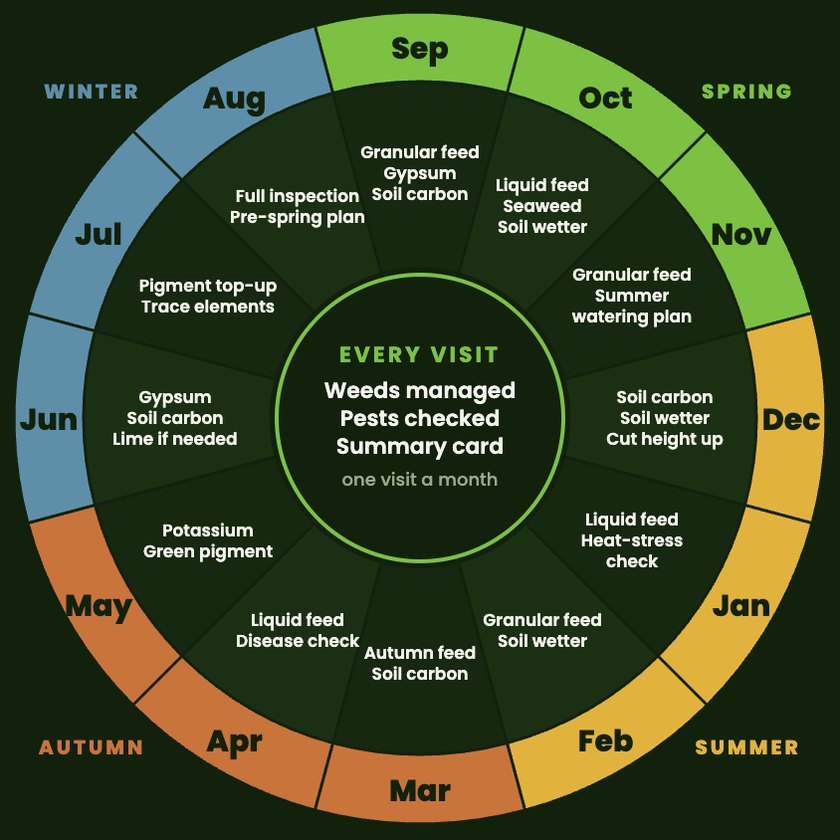
Gypsum adds calcium, which displaces the sodium that makes clay disperse, so the particles clump into crumbs instead of sealing flat. It does the most on sodic clay, and it works slowly, over months. It isn't a fix on its own: spread after coring, alongside soil carbon, it gets into the profile instead of sitting on top.
4. Put carbon back
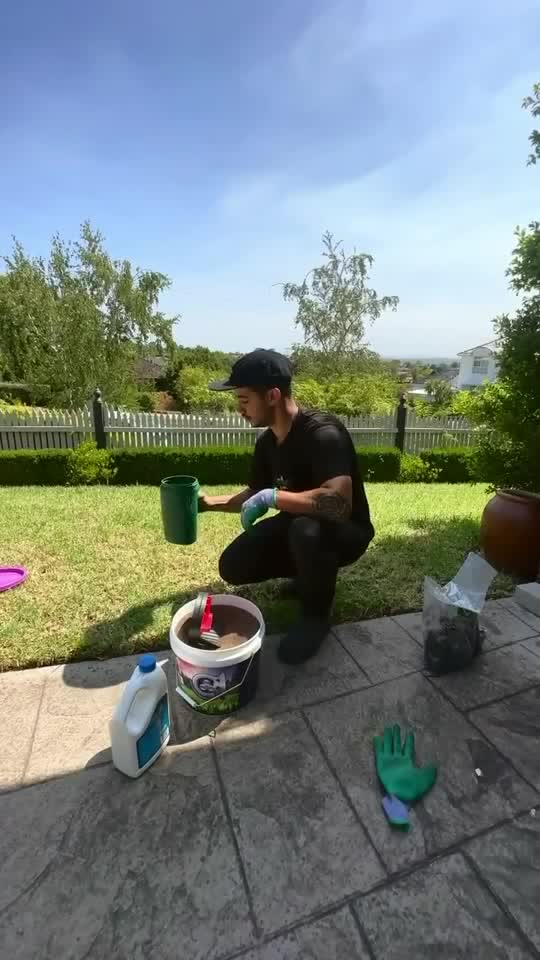
Healthy soil is alive. Humic soil carbon, fulvic acid and seaweed support the microbes and fungi that build soil structure from the inside, binding clay into the crumbly, open texture roots need. This is the slow work that helps everything else hold. (More on this in Your lawn is a living system.)
5. Change how it's mown and watered
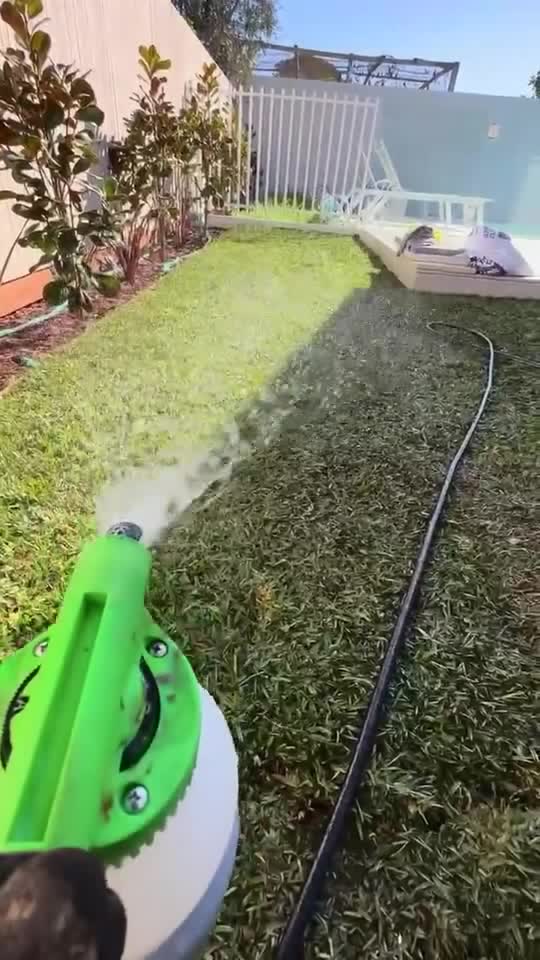
Mow at the top of the right range for your grass, especially through summer, so the roots go deeper. Water deeply and less often, and on clay in short cycles with a soak in between, so the water goes in rather than running off. Where foot traffic wears a track every season, a stepping-stone path is cheaper than fighting it.
How long does it take to improve a clay lawn?
Soil doesn't change in a visit. On most clay lawns the first sign is water soaking in rather than pooling, and the lawn holding its colour a little longer into a hot week. With steady care, by the second spring the roots are usually deeper, thin patches have had a chance to fill, and the same weeds have less bare ground to come back into. Every lawn is different, so we track yours against its own baseline. The aim is a lawn that holds up on its own, not one propped up by constant feeding.
Common questions
Why does water pool on my lawn after rain?
On Melbourne clay it's often compaction. Under foot traffic, mowers and winter rain, clay particles pack together until water, air and roots struggle to get through, so rain sits on the surface instead of soaking in. Core aeration and better soil structure help it move down.
Does gypsum work on clay lawns?
Gypsum adds calcium, which displaces the sodium that makes clay disperse, so the particles clump into crumbs instead of sealing flat. It does the most on sodic clay, and it works slowly, over months. It isn't a fix on its own: spread after coring, alongside soil carbon, it gets into the profile instead of sitting on top.
When should you core aerate a clay lawn in Melbourne?
When the grass is actively growing and the soil is moist but not wet: late spring to early autumn for warm-season grasses like couch, kikuyu and buffalo, and autumn (or spring) for cool-season grasses like tall fescue. Once a year suits most lawns; a hard-used clay lawn may need it twice.
Is coring included in the Infinity Lawns Program?
No. Gypsum, a humic soil carbon spread every season and soluble humates in our liquid feeds are part of the program. Coring and aeration aren't included: where your lawn needs them, we quote them separately in writing, and nothing is added to your bill without your written agreement.
Not sure what's under your lawn? The Infinity Lawns Program is 12 specialist visits a year, and visit 1 is your Lawn Performance Assessment, included: we measure the lawn and test the soil, then send your written report and 12-month program within about 48 hours.
See plans and pricesRather start on your own? Your Summer Water Plan shows how to water clay so it soaks in.
Lawn care as custodianship: we facilitate rather than impose, listening as much as we tend, and working with the rhythms of the living soil rather than against them.
Greenshift Infinity Lawns acknowledges the Wurundjeri Woi-wurrung and Bunurong / Boon Wurrung peoples of the Kulin Nation, the Traditional Owners and Custodians of the lands and waters of Melbourne's inner south-east on which we work. We pay our respects to Elders past and present, and recognise their continuing connection to this land, its waters, and its skies.